SDK-compliant module type
Orbit Determination
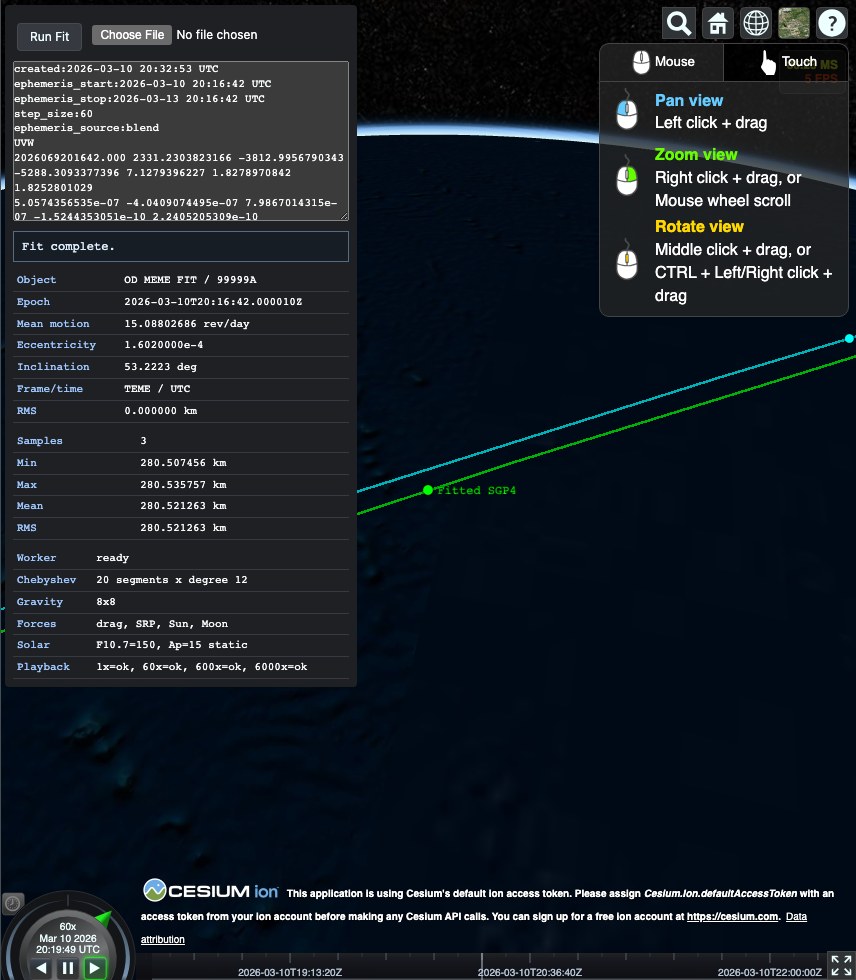
Orbit determination modules estimate state, covariance, and residual quality from measurements while preserving the same module packaging contract as propagators. The SupGP workflow fits near-term SGP4/OMM mean elements from OEM-compatible operator ephemerides and gates quality against CelesTrak RMS.
What it can do
Run batch least squares, sequential filters, measurement fitting, covariance updates, residual analysis, and near-term SupGP generation for radar, optical, GPS, or ephemeris-derived observations.
Reference modules
space-data-network-modules/analysis/odspace-data-network-modules/propagator/hpop
Contract shape
Inputs include OEM-compatible state-vector ephemerides, observations, station metadata, priors, process noise, force settings, and solve controls. Outputs include SupGP/OMM mean elements, estimated states, covariance, residuals, fit metrics, and rejection diagnostics.
Authoring checklist
- Use SDS measurement and covariance records for every port.
- Expose convergence and rejected-observation details, not just the final state.
- Test against public OD problems or independently generated truth cases.
- Keep a reference-suite gate where OrbPro RMS is lower than the matching CelesTrak SupGP RMS for every checked-in case.
- Keep stochastic assumptions explicit in the manifest and output metadata.